East India, Mizoram, Meghalaya, Bihar, Jharkhand, Odisha, Assam, Nagaland, West Bengal, Sikkim, Tripura
About Pollution Control Display Board
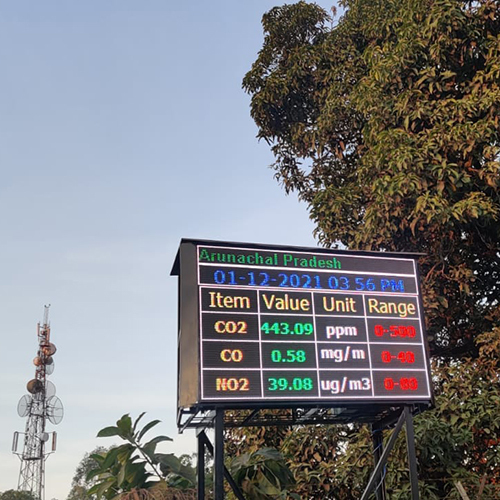
A Pollution Control Display Board (also known as a Pollution Parameter Display Board, Environmental Data Display Board, or AQI Display Board) is a specialized LED display system designed to publicly showcase real-time environmental data, particularly related to air and water quality.These boards play a crucial role in promoting environmental transparency, public awareness, and regulatory compliance for industries and government bodies.
What it Displays:
Pollution Control Display Boards typically show dynamic data for various parameters, which can include:
Air Quality Parameters:
Air Quality Index (AQI):A single composite number indicating the overall air quality.
Particulate Matter (PM2.5, PM10):Fine inhalable particles that can penetrate deep into the lungs.
Industry-specific parameters as per regulatory consent.
How it Works:
Sensors/Analyzers: Specialized environmental sensors and continuous emission/effluent monitoring systems (CEMS/CEQMS or OCEMS) are deployed at various points (e.g., industrial stacks, wastewater discharge points, ambient air locations) to continuously measure pollutant concentrations.
Data Acquisition System: These sensors transmit data to a data acquisition system (DAS) or data logger.
Data Transmission: The collected data is then sent to a central server or cloud platform. This transmission can occur via various methods like Modbus, RS485, Ethernet, Wi-Fi, GPRS/3G/4G, or APIs.
Data Processing & Storage: The central system processes, stores, and validates the real-time data. It might also calculate the AQI based on the individual pollutant levels.
Display Integration: The processed data is then fed to the LED display board's control system.
Public Display:The LED display board presents this data in a clear, legible, and often graphical format for public viewing. Many boards are designed to adhere to specific regulatory formats, such as those prescribed by the Central Pollution Control Board (CPCB) in India.
Key Features:
Real-time Data Display:Shows live updates of pollution parameters.
High Brightness & Visibility: Often designed for outdoor use, ensuring readability even in direct sunlight.
Weatherproof Design (IP Rated):For outdoor applications, they come with high IP (Ingress Protection) ratings (e.g., IP65, IP67) to withstand dust, rain, and extreme temperatures.
Customizable Size and Format: Available in various dimensions and can be tailored to display specific parameters as per compliance requirements.
Connectivity Options: Support multiple communication protocols (RS232, RS485, Ethernet, Wi-Fi, GPRS, USB) for seamless integration with monitoring equipment.
CPCB/SPCB Compliance: Many boards are specifically designed to meet the guidelines and format requirements of the Central Pollution Control Board (CPCB) and State Pollution Control Boards (SPCBs) in India.
Durable Construction: Made from robust materials like MS (Mild Steel) or aluminum for longevity.
Software & Cloud Monitoring:Often come with user-friendly software or cloud-based platforms for remote data access, report generation, and system health monitoring.
Multi-color or Single-color: Can display data in single colors (red, green, amber) or full-color for more graphical representations.
Alerts and Notifications: Some systems can be configured to trigger alarms or send alerts if pollution levels exceed predefined thresholds.
Importance and Applications:
Regulatory Compliance:Mandatory for many industries (especially those categorized as Red or Orange by CPCB) to publicly display their pollution data.
Public Awareness: Informs citizens about local air and water quality, promoting environmental consciousness.
Transparency: Increases accountability for industries and government bodies regarding environmental management.
Environmental Monitoring:Helps track trends in pollution levels, assess the effectiveness of control measures, and identify pollution hotspots.
Smart City Initiatives: Integral part of smart city projects to provide real-time environmental information.
Industrial Premises:Displaying stack emission levels and hazardous waste details to workers and the public.
Public Places: Railway stations, bus stands, airports, urban centers, and public parks.
Tell us about your requirement
Price:
Quantity
Select Unit
50
100
200
250
500
1000+
Additional detail
Mobile number
Email
Name
Comapny Name
Phone Number
Email Id
City / State
Confirm Your Requirement
Verification Code
Did not receive yet?
Resend OTP
You’re Done!
We have received your requirements and will reply shortly with the best price.
Products You May Like
X
×
Add a mobile number to receive call from "Wise Solutions"
×
Enter OTP
×
Share additional details for a quick response
×
Thank You!
Thank You for your valuable time. We have received your details and will get back to you shortly.
✕
Contact Us
Name
Comapny Name
Phone Number
Email Id
City / State
OTP Verification
Verification Code
Did not receive yet?
Resend OTP
Thank you!
We have received your requirements
For an immediate response, please call this number 08045476834
✕
Tell us about your requirement
Price:
Quantity
Select Unit
Additional detail
Mobile number
Email
Name
Comapny Name
Phone Number
Email Id
City / State
Confirm Your Requirement
Verification Code
Did not receive yet?
Resend OTP
You’re Done!
We have received your requirements and will reply shortly with the best price.


 Send Inquiry


 Send Inquiry


 English
 Spanish
 French
 German
 Italian
 Chinese (Simplified)
 Japanese
 Korean
 Arabic
 Portuguese
